Open in CoCalc with one click!

Do this first!

Please make a copy of this file called Assignment_5_turnin.sagews. That file (or a corresponding Jupyter notebook with extension .ipynb) will be graded by the grader.

Assignment 5

Please do the following problems.

5.9: Theory Exercises

These problems may be written by hand and turned in, or they may be typeset in this Jupyter notebook or in a Sage worksheet.

1. Problem 5.9.3

n=3 f(x)=e^(-x^2) a=0 b=1 h=(b-a)/n Trap=h/2*(f(a)+2*(f(a+h)+f(a+2*h))+f(b)) print 'The answer for this integral calculated with the Composite Trapezoidal Rule is', Trap.n(digits=5) fp(x)=diff(f(x),x) fpp(x)=diff(fp(x),x) p1=plot(f(x),(x,0,1), color="green",legend_label="F(x)") p2=plot(fp(x),(x,0,1), color="blue",legend_label="First Derivative") p3=plot(fpp(x),(x,0,1), color="red",legend_label="Second Derivative") show(p1+p2+p3) #max of fpp(x) is at x=0 where y=-2 error=(b-a)*h^2/12*fpp(0) print 'The error of approximation is', error.n(digits=5)
The answer for this integral calculated with the Composite Trapezoidal Rule is 0.73999
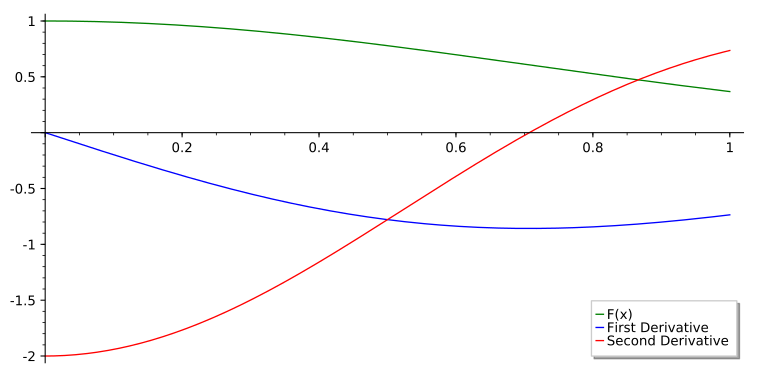
The error of approximation is -0.018519

2. Problem 5.9.4

n=2 f(x)=e^(-x^2) a=0 b=1 h=(b-a)/n Simpson=h/3*(f(a)+4*f(a+h)+f(b)) print 'The answer for this integral calculated with the Composite Simpson Rule is', Simpson.n() fp(x)=diff(f(x),x) fpp(x)=diff(fp(x),x) fppp(x)=diff(fpp(x),x) fpppp(x)=diff(fppp(x),x) fppppp(x)=diff(fpppp(x),x) p1=plot(f(x),(x,0,1), color="green",legend_label="F(x)") p2=plot(fp(x),(x,0,1), color="blue",legend_label="First Derivative") p3=plot(fpp(x),(x,0,1), color="red",legend_label="Second Derivative") p4=plot(fpp(x),(x,0,1), color="orange",legend_label="Third Derivative") p5=plot(fppp(x),(x,0,1), color="purple",legend_label="Fourth Derivative") p6=plot(fpppp(x),(x,0,1), color="yellow",legend_label="Fifth Derivative") show(p1+p2+p3+p4+p5+p6) #max of fpppp(x) is at x=0.525 where y=4 error=(b-a)*h^4/180*fpppp(0.525) print 'The error of approximation is', error.n(digits=4)
The answer for this integral calculated with the Composite Simpson Rule is 0.747180428909510
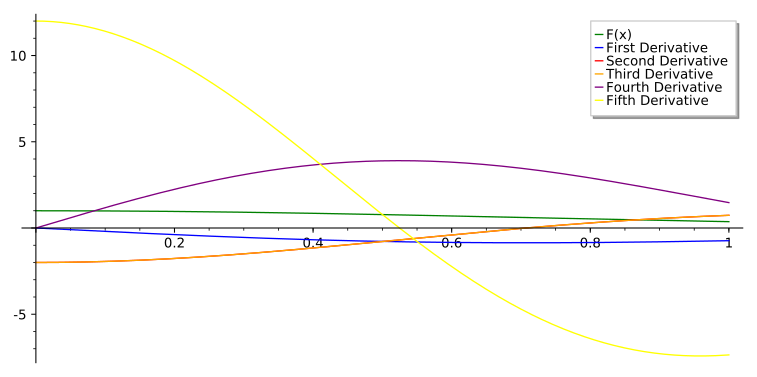
The error of approximation is -3.820e-6

3. Problem 5.9.16

n=4 f(x)=arctan(x) a=0 b=1 h=(b-a)/n Trap=h/2*(f(a)+2*(f(a+h)+f(a+2*h)+f(a+3*h))+f(b)) print 'The answer for this integral calculated with the Composite Trapezoidal Rule is', Trap.n(digits=5) fp(x)=diff(f(x),x) fpp(x)=diff(fp(x),x) fppp(x)=diff(fpp(x),x) p1=plot(f(x),(x,0,1), color="green",legend_label="F(x)") p2=plot(fp(x),(x,0,1), color="blue",legend_label="First Derivative") p3=plot(fpp(x),(x,0,1), color="red",legend_label="Second Derivative") p4=plot(fppp(x),(x,0,1), color="yellow",legend_label="Third Derivative") show(p1+p2+p3+p4) #max of fpp(x) is at x=0.575 where y=-0.7 error=(b-a)*h^2/12*fpp(0.575) print 'The error of approximation is', error.n(digits=5)
The answer for this integral calculated with the Composite Trapezoidal Rule is 0.43621
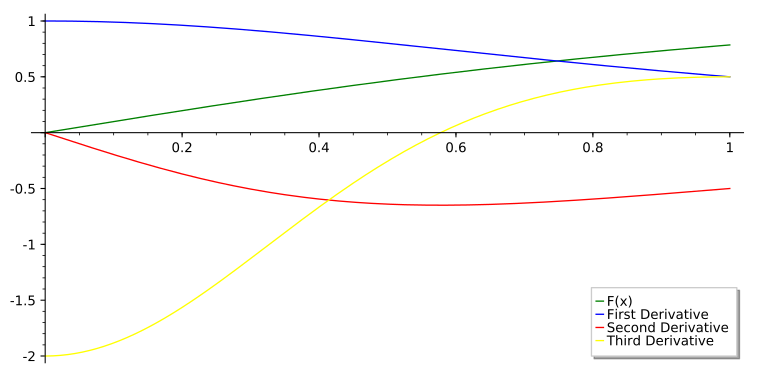
The error of approximation is -0.0033829

4. Problem 5.9.17

n=4 f(x)=arctan(x) a=0 b=1 h=(b-a)/n Simpson=h/3*(f(a)+4*f(a+h)+2*f(a+2*h)+4*f(a+3*h)+f(b)) print 'The answer for this integral calculated with the Composite Simpson Rule is', Simpson.n(digits=5) fp(x)=diff(f(x),x) fpp(x)=diff(fp(x),x) fppp(x)=diff(fpp(x),x) fpppp(x)=diff(fppp(x),x) fppppp(x)=diff(fpppp(x),x) p1=plot(f(x),(x,0,1), color="green",legend_label="F(x)") p2=plot(fp(x),(x,0,1), color="blue",legend_label="First Derivative") p3=plot(fpp(x),(x,0,1), color="red",legend_label="Second Derivative") p4=plot(fpp(x),(x,0,1), color="orange",legend_label="Third Derivative") p5=plot(fppp(x),(x,0,1), color="purple",legend_label="Fourth Derivative") p6=plot(fpppp(x),(x,0,1), color="yellow",legend_label="Fifth Derivative") show(p1+p2+p3+p4+p5+p6) #max of fpppp(x) is at x=0 where y=-2 error=(b-a)*h^4/180*fpppp(0) print 'The error of approximation is', error.n(digits=8)
The answer for this integral calculated with the Composite Simpson Rule is 0.43888
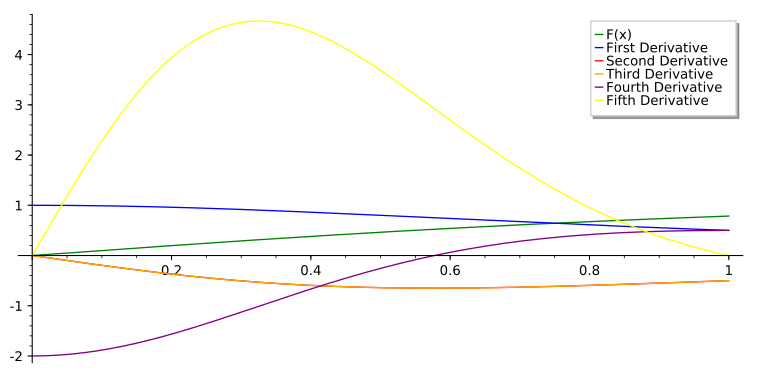
The error of approximation is 0.00000000

5. Problem 5.9.18

x0=0.2 x1=0.4 x2=0.6 x3=0.8 x4=1.0 y0=7.11 y1=10.21 y2=20.98 y3=32.91 y4=1.12 h=(1-.2)/4 trap=(h/2)*(y0+y4)+h*(y1+y2+y3) print 'The estimate of the integral using the Composite Trapezoidal Method is', trap.n(digits=5)
The estimate of the integral using the Composite Trapezoidal Method is 13.643

6. Problem 5.9.19

x0=0.2 x1=0.4 x2=0.6 x3=0.8 x4=1.0 y0=7.11 y1=10.21 y2=20.98 y3=32.91 y4=1.12 h=(1-.2)/4 simpson=h/3*(y0+4*y1+2*y2+4*y3+y4) print 'The estimate of the integral using the Composite Simpson Method is', simpson.n(digits=5)
The estimate of the integral using the Composite Simpson Method is 14.845

7. Problem 5.9.21
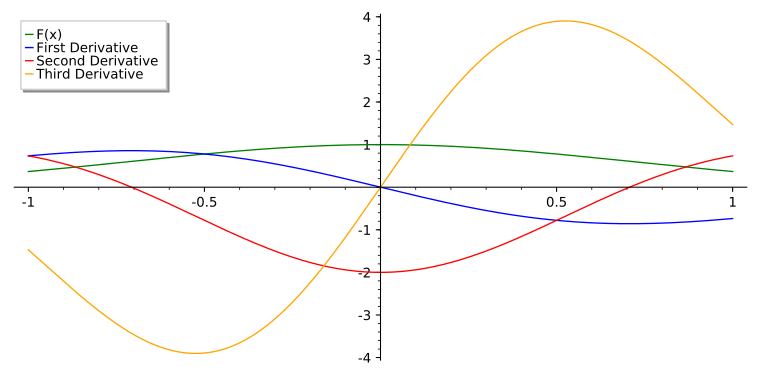
f(x)=e^(-x^2) a=-1 b=1 h=(b-a)/n error=0.0001 fp(x)=diff(f(x),x) fpp(x)=diff(fp(x),x) fppp(x)=diff(fpp(x),x) p1=plot(f(x),(x,-1,1), color="green",legend_label="F(x)") p2=plot(fp(x),(x,-1,1), color="blue",legend_label="First Derivative") p3=plot(fpp(x),(x,-1,1), color="red",legend_label="Second Derivative") p4=plot(fppp(x),(x,-1,1), color="orange",legend_label="Third Derivative") show(p1+p2+p3+p4) abs(fpp(0)) #0.0001=(1/6)*2*(2/n)^2 #0.0001*6/2=(2/n)^2 #sqrt(0.0001*3)=2/n n=2/sqrt(0.0001*3) print n print 'Round up to 116 nodes.'
2 115.470053837925 Round up to 116 nodes.

5.10: Computer Exercises.

Please use Sage to do the following problem. Do not use the built-in Python functions for the trapezoidal or Simpson's rule.

8. Problem 5.10.1

def CompositeTrap (f,a,b,n): h=(b-a)/n sum=1/2*f(a) for i in [1,2,..,n-1]: sum+=f(a+i*h) sum+=1/2*f(b) sum=sum*h return sum f(x)=exp(-x^2) fp(x)=diff(f(x),x) fpp(x)=diff(fp(x),x) a=0 b=1 print 'n', '\t','trapezoidal', '\t\t', 'actual error', '\t\t', 'estimated error' print '------------------------------------------------------------------------' for power in [0,1,2,3,4,5]: n=2^power h=(b-a)/n trap=CompositeTrap(f,a,b,n).n() actualerror=(trap-numerical_integral(f,a,b)[0]).n() estimatederror=(b-a)*h^2/12*fpp(0).n(digits=5) print n, '\t', trap,'\t',actualerror, '\t', estimatederror
n trapezoidal actual error estimated error ------------------------------------------------------------------------ 1 0.683939720585721 -0.0628844122267058 -0.16667 2 0.731370251828563 -0.0154538809838640 -0.041667 4 0.742984097800381 -0.00384003501204577 -0.010417 8 0.745865614845695 -0.000958517966731742 -0.0026042 16 0.746584596788222 -0.000239536024205456 -0.00065104 32 0.746764254652294 -0.0000598781601327536 -0.00016276

9. Problem 5.10.2

def CompositeSimpson(f,a,b,n): if int(n)%2==1: return "ERROR-n should be even!!!" h=(b-a)/n sum=f(a) for i in [1,2..,n-1]: if(i%2==1): sum+=4*f(a+i*h) else: sum+=2*f(a+i*h) sum+=f(b) sum=sum*h/3 return sum f(x)=exp(-x^2) fp(x)=diff(f(x),x) fpp(x)=diff(fp(x),x) fppp(x)=diff(fpp(x),x) fpppp(x)=diff(fppp(x),x) a=0 b=1 print 'n', '\t','simpsons', '\t\t', 'actual error', '\t\t', 'estimated error' print '------------------------------------------------------------------------' for power in [1,2,3,4,5]: n=2^power h=(b-a)/n simpsons=CompositeSimpson(f,a,b,n).n() actualerror=(simpsons-numerical_integral(f,a,b)[0]).n() estimatederror=(b-a)*h^4/180*fpppp(0.525).n(digits=5) print n, '\t', trap,'\t',actualerror, '\t', estimatederror
n simpsons actual error estimated error ------------------------------------------------------------------------ 2 0.746764254652294 0.000356296097083320 -3.8202e-6 4 0.746764254652294 0.0000312469785601621 -2.3876e-7 8 0.746764254652294 1.98771503967521e-6 -1.4923e-8 16 0.746764254652294 1.24623303232596e-7 -9.3267e-10 32 0.746764254652294 7.79455788801897e-9 -5.8292e-11

10. Problem 5.10.5
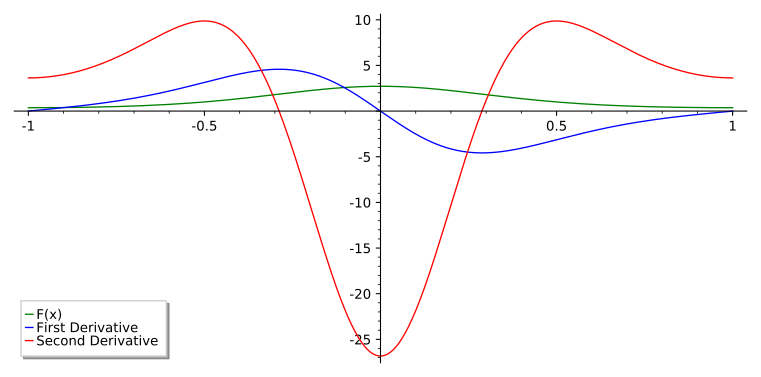
f(x)=exp(cos(pi*x)) fp(x)=diff(f(x),x) fpp(x)=diff(fp(x),x) a=-1 b=1 p1=plot(f(x),(x,-1,1), color="green",legend_label="F(x)") p2=plot(fp(x),(x,-1,1), color="blue",legend_label="First Derivative") p3=plot(fpp(x),(x,-1,1), color="red",legend_label="Second Derivative") show(p1+p2+p3) print 'n', '\t','trapezoidal', '\t\t', 'actual error', '\t\t', 'estimated error' print '------------------------------------------------------------------------' for power in [0,1,2,3,4,5]: n=2^power h=(b-a)/n trap=CompositeTrap(f,a,b,n).n() actualerror=(trap-numerical_integral(f,a,b)[0]).n() estimatederror=(b-a)*h^2/12*fpp(0).n(digits=5) print n, '\t', trap,'\t',actualerror, '\t', estimatederror
n trapezoidal actual error estimated error ------------------------------------------------------------------------ 1 0.735758882342885 -1.79637287316113 -17.886 2 3.08616126963049 0.554029514126471 -4.4714 4 2.54308063481524 0.0109488793112269 -1.1178 8 2.53213215392898 3.98424961023380e-7 -0.27946 16 2.53213175550402 -4.44089209850063e-16 -0.069866 32 2.53213175550402 0.000000000000000 -0.017466

11. Problem 5.10.6

f(x)=exp(cos(pi*x)) fp(x)=diff(f(x),x) fpp(x)=diff(fp(x),x) fppp(x)=diff(fpp(x),x) fpppp(x)=diff(fppp(x),x) a=-1 b=1 print 'n', '\t','simpsons', '\t\t', 'actual error', '\t\t', 'estimated error' print '------------------------------------------------------------------------' for power in [1,2,3,4,5]: n=2^power h=(b-a)/n simpsons=CompositeSimpson(f,a,b,n).n() actualerror=(simpsons-numerical_integral(f,a,b)[0]).n() estimatederror=(b-a)*h^4/180*fpppp(0).n(digits=5) print n, '\t', trap,'\t',actualerror, '\t', estimatederror
n simpsons actual error estimated error ------------------------------------------------------------------------ 2 2.53213175550402 1.33749697655567 11.768 4 2.53213175550402 -0.170077998960521 0.73552 8 2.53213175550402 -0.00364909520379397 0.045970 16 2.53213175550402 -1.32808321229305e-7 0.0028731 32 2.53213175550402 -4.44089209850063e-16 0.00017957